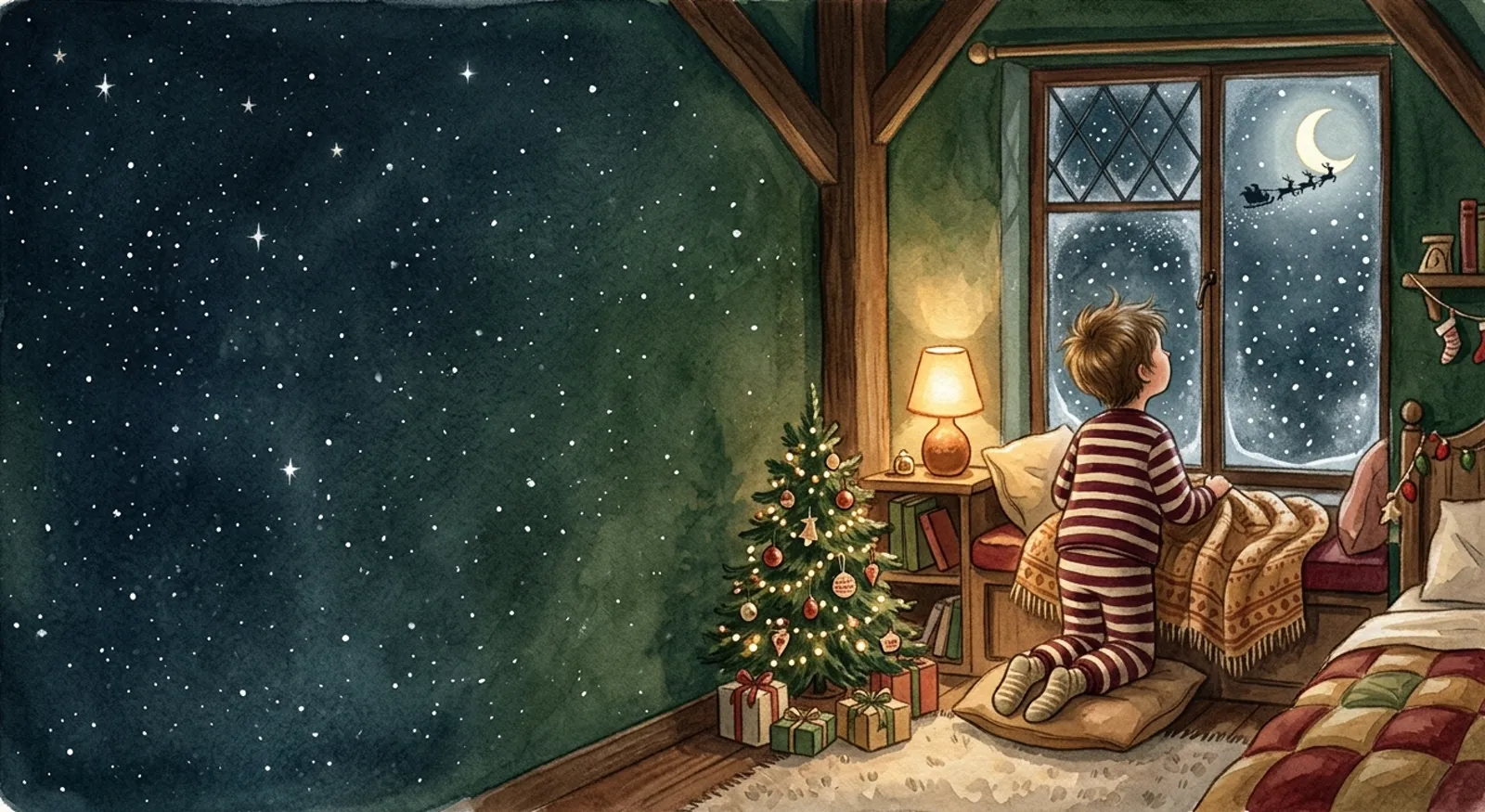
 Illustration
A question as old as Christmas
Is Santa real? Google says no. But is that true?
Ask Google and its AI answer is a flat “No”. In 1897 an eight-year-old girl called Virginia asked a New York newspaper the same question — and its answer became the most famous reply ever printed. Here it is, word for word.
The New York Sun · September 21, 1897
Dear Editor: I am 8 years old.
Some of my little friends say there is no Santa Claus.
Papa says 'If you see it in The Sun it's so.'
Please tell me the truth: is there a Santa Claus?
— Virginia O'Hanlon, 115 West Ninety-fifth Street
Virginia, your little friends are wrong. They have been affected by the skepticism of a skeptical age. They do not believe except they see. They think that nothing can be which is not comprehensible by their little minds. All minds, Virginia, whether they be men's or children's, are little. In this great universe of ours man is a mere insect, an ant, in his intellect, as compared with the boundless world about him, as measured by the intelligence capable of grasping the whole of truth and knowledge.
Yes, Virginia, there is a Santa Claus. He exists as certainly as love and generosity and devotion exist, and you know that they abound and give to your life its highest beauty and joy. Alas! how dreary would be the world if there were no Santa Claus. It would be as dreary as if there were no Virginias. There would be no childlike faith then, no poetry, no romance to make tolerable this existence. We should have no enjoyment, except in sense and sight. The eternal light with which childhood fills the world would be extinguished.
Not believe in Santa Claus! You might as well not believe in fairies! You might get your papa to hire men to watch in all the chimneys on Christmas Eve to catch Santa Claus, but even if they did not see Santa Claus coming down, what would that prove? Nobody sees Santa Claus, but that is no sign that there is no Santa Claus. The most real things in the world are those that neither children nor men can see. Did you ever see fairies dancing on the lawn? Of course not, but that's no proof that they are not there. Nobody can conceive or imagine all the wonders there are unseen and unseeable in the world.
You may tear apart the baby's rattle and see what makes the noise inside, but there is a veil covering the unseen world which not the strongest man, nor even the united strength of all the strongest men that ever lived, could tear apart. Only faith, fancy, poetry, love, romance, can push aside that curtain and view and picture the supernal beauty and glory beyond. Is it all real? Ah, Virginia, in all this world there is nothing else real and abiding.
No Santa Claus! Thank God! he lives, and he lives forever. A thousand years from now, Virginia, nay, ten times ten thousand years from now, he will continue to make glad the heart of childhood.
Written by Francis Pharcellus Church. Public domain; text from Wikisource.
Things that are really, truly true
There really was a Saint Nicholas
More than 1,600 years ago, a bishop called Nicholas lived in the town of Myra, in what is now Turkey. He was famous for giving presents in secret — once dropping bags of gold through a family's window at night. His name, Sinterklaas in Dutch, turned into "Santa Claus".
Grown-ups track his sleigh every year
Since 1955, NORAD — the team that watches the skies over the United States and Canada — has followed Santa's flight on Christmas Eve, and millions of children watch with them.
Children all over the world write to him
Every year children send letters to the North Pole, and helpers answer many of them. You can write yours too.
The best question to ask
If you're wondering, ask a grown-up you love: "What do you think?" You might find out that the magic is bigger than you thought.
For grown-ups onlyA gentle guide for parentsOpen
When children usually stop believing
- Most children work it out between 7 and 9, though some stop at 5 and some keep believing until 11 or 12.
- They find out by asking friends, spotting something that doesn't add up — the same wrapping paper as Mom's, Santa's handwriting — or testing it themselves, like flour by the chimney.
- Reactions vary: in research summarized by McGill University, about a third of children felt sad and one in six angry, while nearly half felt happy — often proud of having figured it out.
When your child asks "Is Santa real?"
- Answer with a question: "What do you think?" Many children want to keep believing and will tell you so — a child who says "I think he's real" isn't asking for the truth yet.
- A child who asks the same question again and again, directly, and gets upset by vague answers is usually ready for an honest one.
- Don't threaten: "If you stop believing, the presents stop" tends to backfire and is the answer people remember with resentment as adults.
How to tell them — the way many families do it
- Start with the real Saint Nicholas: a real man who gave gifts in secret. Then explain that ever since, grown-ups have kept his idea alive by giving presents secretly, too.
- Make it a promotion, not a loss: "You're old enough now to be in on the secret — you get to be a Santa too." Let them choose a secret gift for a sibling, a neighbor or a toy drive this year.
- Ask them to keep the secret for younger children. Most kids love being on the grown-ups' side of the magic.
- Give them something to keep: a letter saying they're now part of Santa's team (you can print one below).
When someone else spoils it
- A teacher, a cousin or a TV ad says Santa isn't real: "Some people believe and some don't. What do you believe?" buys time and lets your child lead.
- If your child is clearly shaken and asking for the truth, this can be the moment for the honest, gentle version above rather than a cover story.
- Teach them the same kindness for other kids: every family does Christmas its own way, so we don't tell other children what to believe.
Children who take things literally
- Autistic and very literal-minded children may never doubt — and may feel deeply betrayed when they find out, especially if it comes as a shock from someone else.
- If your child asks directly and clearly wants a straight answer, a straight, warm answer usually lands better than a mystical one. Explain the tradition as a game the whole family plays together, and why people love it.
A letter for the big day
Many families mark the moment with a letter that welcomes the child onto “Santa's team”. Add the names and print it.
Free, no sign-up. The names stay in your browser.
A VERY SPECIAL LETTER
Welcome to Santa's team
Dear my dear,
You asked a big question, and you're old enough now to hear the whole answer.
Long ago there lived a man called Nicholas who gave presents in secret, just to make people happy. Ever since, people all over the world have kept his idea alive: every Christmas, the people who love you quietly become Santa.
That was us. Every present, every cookie crumb, every reindeer footprint — it was love, dressed up as magic. And the magic was real, because the love was.
Now you're part of the secret. This year you get to be a Santa, too: choose someone to surprise, and help us keep the magic safe for the little ones who still believe.
With all our love,
Mom & Dad
Sources: McGill University Office for Science and Society, “When kids learn the truth about Santa” (2025); parents' experiences shared on Reddit (r/Parenting, r/Preschoolers), summarized in our own words.
Questions
Was Santa Claus a real person?
Santa Claus grew out of a real person: Saint Nicholas, a 4th-century bishop of Myra, in present-day Turkey, known for giving gifts in secret. The Dutch Sinterklaas and, later, the American Santa Claus grew out of his story.
Is Santa real — yes or no?
Many families answer the way The New York Sun did in 1897: "Yes, Virginia, there is a Santa Claus. He exists as certainly as love and generosity and devotion exist." The best person to ask is a grown-up you love — ask them what they think.
Does Santa exist, yes or no?
Not as a man who flies around the world in one night — that part is a story. But he is built on a real person, Saint Nicholas, and on a very real tradition of secret giving that parents, neighbours and volunteers keep alive every year. That is why many people still answer, "Yes, Virginia."
Is Santa real, or is it just my parents?
In most homes the presents come from parents and family; the "Santa" part is a shared family tradition. Many children learn this gradually, and most are fine with it — what they remember is the wonder and the fact that someone went to the trouble. Parents can say so gently and invite the child to help keep the magic going for others.
Is Santa real? What does the AI answer say?
Search engines' AI summaries usually give a flat "no" and stop there. A fuller answer: no flying sleigh you can photograph, but a real Saint Nicholas behind the legend, real gift-giving in his name, and an 1897 newspaper reply that is still read each Christmas.
At what age do kids stop believing in Santa?
Most children stop believing between the ages of 7 and 9, usually by working it out themselves or hearing it from other children.
Should I tell my 10-year-old about Santa?
If they're asking directly and repeatedly, they're probably ready. Tell them gently, starting with the real Saint Nicholas, and invite them to become a secret Santa themselves.