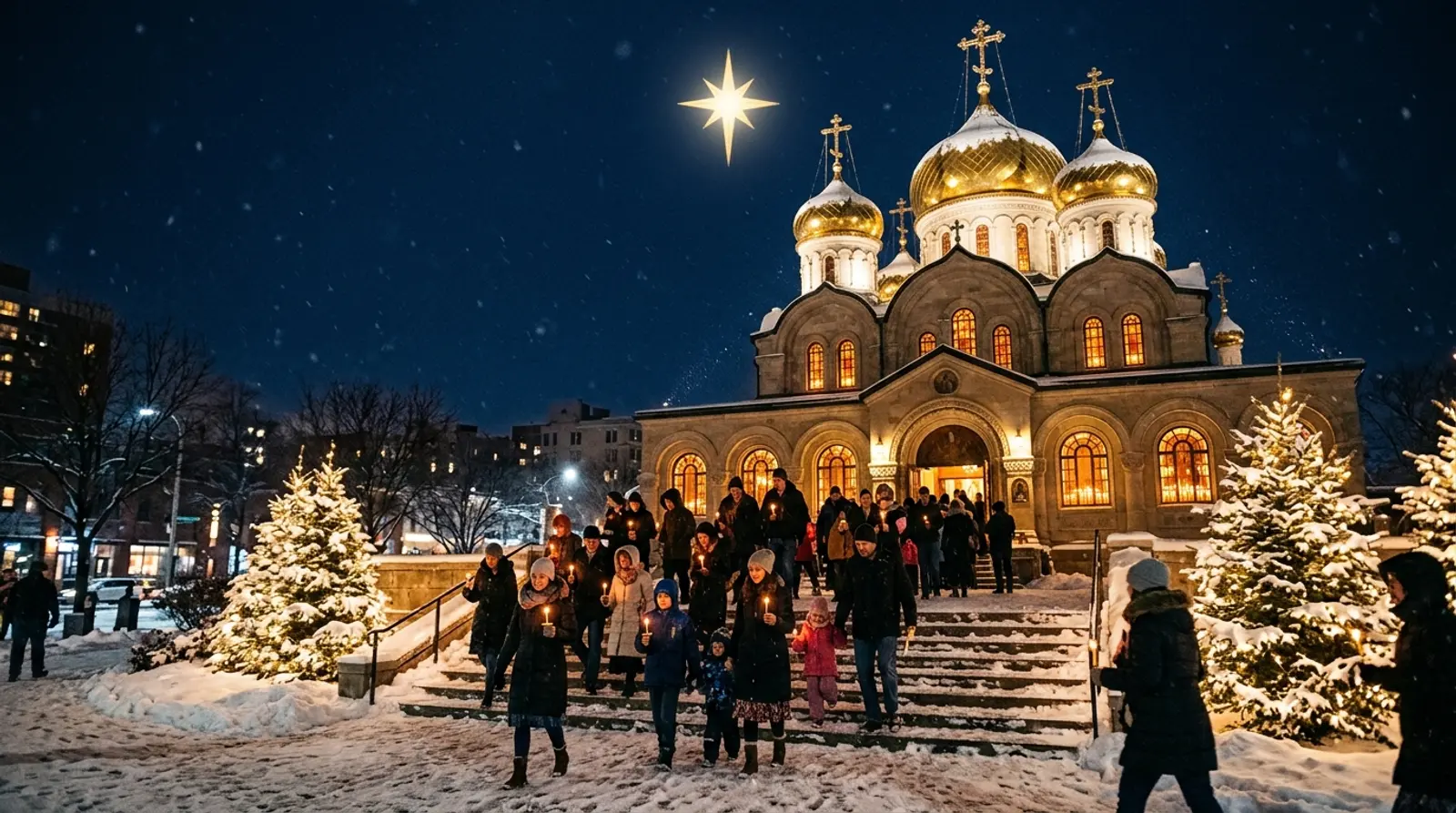
 Illustration
Christmas by the old calendar · January 7
Orthodox Christmas on January 7: why the date differs, how each community celebrates, and where to go in the US
When most of America is taking the tree down, Russian, Serbian, Ethiopian and Coptic families are just sitting down to Christmas Eve. Here is why their Christmas falls on January 7, how each community keeps it — from the twelve-dish Holy Supper to the oak-branch badnjak — and every church in the US where you can join the night service, over a thousand of them.
1,086 churches in 50 states · checked September 2026
📍 Find one near youuntil Orthodox Christmas
Why is Orthodox Christmas on January 7?
It is still December 25 — just on the old Julian calendar, which is now thirteen days behind the Gregorian calendar the rest of the world uses. Churches that kept the Julian calendar for their feasts celebrate the Nativity on what is, for everyone else, January 7. Christmas Eve is January 6.
In 2027 Orthodox Christmas falls on a Thursday, with Christmas Eve on Wednesday, January 6. Because the gap between the calendars grows by a day every century, it will move to January 8 in 2101.
Who celebrates on which day
January 7: the Russian, Serbian, Georgian, Macedonian and Jerusalem Orthodox churches, and — by their own ancient calendars — the Ethiopian and Coptic churches. January 6: the Armenian Apostolic Church, which keeps the Nativity and Christ's baptism together as one feast.
December 25: the Greek, Antiochian, Romanian and Bulgarian churches and most parishes of the Orthodox Church in America, which adopted a revised calendar in the last century. Ukraine's main churches moved to December 25 in 2023; many Ukrainian parishes in the US followed, and some still keep January 7 — the parish calendar will say.
Christmas Eve and the Holy Supper
Christmas Eve ends a forty-day Nativity fast, and in Ukrainian, Russian, Belarusian and Rusyn homes the day is kept quiet until the first star appears in the evening sky. Then the family sits down to the Holy Supper — Sviata Vecheria in Ukrainian: twelve meatless dishes for the twelve apostles, with hay under the tablecloth for the manger and often a place set for relatives who have died.
The first dish is kutia: boiled wheat berries with poppy seeds, honey and walnuts. Then come borscht with little mushroom dumplings, varenyky with potato or cabbage, fish, stuffed cabbage with rice, mushrooms and beans, and uzvar, a smoky compote of dried fruit. After supper the family goes to the night service or goes carolling.
 Photo: Віщун · CC BY-SA 4.0
Serbian Christmas: the badnjak
On Serbian Christmas Eve, Badnji dan, families bring home the badnjak — a young oak branch, sold today in bundles with wheat and evergreen — and in the evening it is blessed and burned; in the US most parishes light a badnjak bonfire in the churchyard after the evening service. Straw is spread on the floor for the manger.
On Christmas morning the first visitor, the položajnik, brings luck for the year, and the family breaks the česnica, a round bread with a coin baked inside for whoever finds it. The greeting all day is 'Hristos se rodi!' — Christ is born — answered with 'Vaistinu se rodi!' — truly he is born.
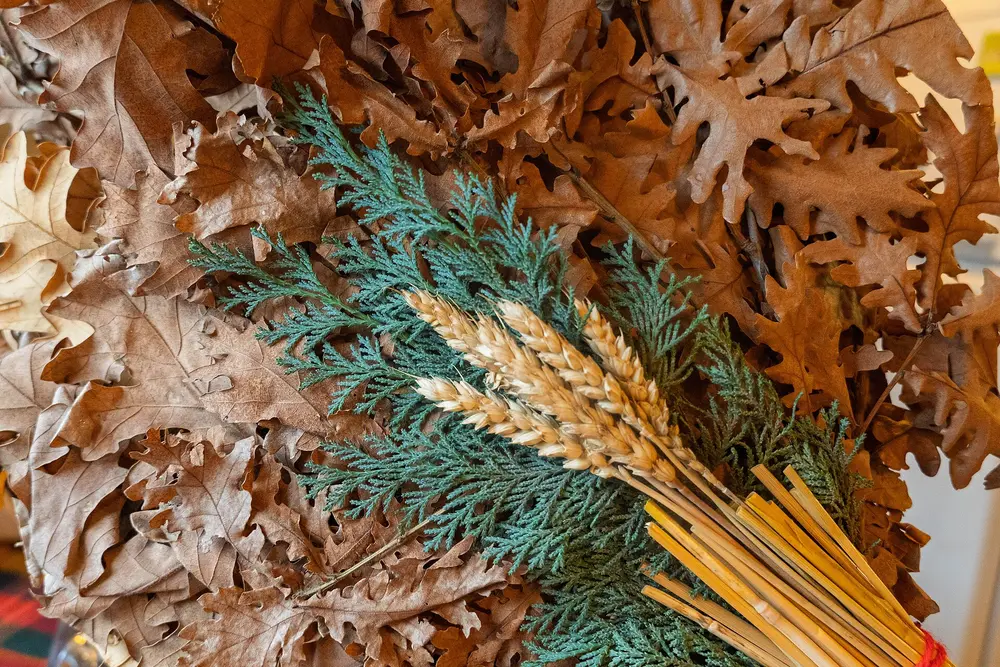 Photo: MikyM · CC BY-SA 4.0
Ethiopian, Coptic and Armenian Christmas
Ethiopian Christmas, Genna, comes after a long Advent fast. Worshippers dress in white, the women in the light cotton shawl called a netela, and the service lasts through the night; the feast afterwards centres on doro wat, the spiced chicken stew, with injera.
Coptic Christians fast for 43 days, then gather on the night of January 6 for a liturgy that ends after midnight; the fast is broken with a family feast of fatta — rice, bread and meat with garlic and vinegar. Armenian Christmas is on January 6, with a Christmas Eve meal of fish, rice and dried fruit the night before and the blessing of water in church on the day.
How to say Merry Christmas
Russian: 'S Rozhdestvom Khristovym!' — or simply 'S Rozhdestvom!'. Ukrainian: 'Khrystos narodyvsia!' — Christ is born — answered with 'Slavimo Yoho!', let us glorify him. Serbian: 'Hristos se rodi!' and 'Vaistinu se rodi!'. Greek: 'Kala Christougenna!'. Amharic, for Ethiopian friends: 'Melkam Genna!'. Armenian: 'Shnorhavor Surb Tsnund!'.
The Orthodox season continues after Christmas: many Russian and Ukrainian families also celebrate the Old New Year on the night of January 13 to 14 — New Year's Eve by the old calendar.
Landmark cathedrals for Christmas Eve
The great cathedrals of each community, whose own pages or dioceses confirm their Christmas services on the old-calendar dates. Below them is the full directory — every church in the US that keeps Christmas in January, with a “near me” search.
By city
New York, NY
Upper East Side
Russian Orthodox Cathedral of St. Nicholas
The landmark red-brick cathedral of the Russian Orthodox Church's parishes in the US, with its five onion domes. The Christmas Eve service begins on the evening of January 6, the festal liturgy follows on the 7th.
Last held: January 6–7, 2026
Upper East Side
Synodal Cathedral of the Sign
The cathedral of the Russian Orthodox Church Outside of Russia, a few blocks from St. Nicholas: an all-night vigil on Christmas Eve and a bishop-led festal liturgy on January 7.
Last held: Every January 6–7
Murray Hill
St. Vartan Armenian Cathedral
Armenian Christmas: the Christmas Eve liturgy on the evening of January 5, and on January 6 the Nativity and Theophany service with the blessing of water.
Last held: January 5–6, 2026
San Francisco, CA
Richmond District
Holy Virgin Cathedral (Joy of All Who Sorrow)
The largest cathedral of the Russian Church Abroad, with golden domes over Geary Boulevard. Christmas Eve begins with vespers and the Liturgy of St Basil on the morning of January 6, then the night vigil.
Last held: January 6–7, 2026
Chicago, IL
Northwest Side
Holy Resurrection Serbian Orthodox Cathedral
The cathedral of Chicago's large Serbian community. As in Serbian parishes everywhere, Christmas Eve on January 6 brings vespers and the blessing of the badnjak, with the Christmas liturgy on the 7th.
Last held: Every January 6–7
Los Angeles, CA
Alhambra
St. Steven's Serbian Orthodox Cathedral
The Serbian cathedral of the Western US, in the San Gabriel Valley, where Southern California's Serbian community gathers for Christmas Eve and the Christmas liturgy.
Last held: Every January 6–7
Washington, DC
Petworth
Debre Selam Kidist Mariam Ethiopian Orthodox Church
The largest Ethiopian Orthodox parish in the Washington area, home to America's biggest Ethiopian community. Genna is kept with an all-night service, the congregation dressed in white.
Last held: Every January 6–7
Jersey City, NJ
West Side
St. Mark Coptic Orthodox Church
The first Coptic Orthodox church in North America, founded around 1970 in a city with one of the largest Coptic communities in the US. The Christmas liturgy runs through the night of January 6 and ends the 43-day fast.
Last held: Every January 6–7
Find an Orthodox church near you for Christmas
Every church in the US that keeps Christmas in January — 1,086 of them in 50 states: 310 Russian, 196 Coptic, 157 Ethiopian, 127 Serbian, 88 Ukrainian, 87 Armenian, 72 Carpatho-Russian, 30 Eritrean, 12 Macedonian, 7 Georgian. Tap “Near me” for the closest, or pick a state.
Sources: the parish directory of the Assembly of Canonical Orthodox Bishops of the USA (Russian, Serbian, Georgian, Carpatho-Russian and Ukrainian parishes), the Coptic Church's own directory, and Google Maps for Ethiopian, Eritrean, Armenian and Macedonian churches in the 40 largest metro areas — checked September 2026. Service times are set in December; always check with the parish.
Loading the directory…
Orthodox Christmas churches by state
- Alabama (9)
- Alaska (2)
- Arizona (19)
- Arkansas (6)
- California (162)
- Colorado (8)
- Connecticut (14)
- Delaware (3)
- Florida (46)
- Georgia (19)
- Hawaii (4)
- Idaho (2)
- Illinois (46)
- Indiana (27)
- Iowa (6)
- Kansas (5)
- Kentucky (3)
- Louisiana (4)
- Maine (8)
- Maryland (35)
- Massachusetts (16)
- Michigan (31)
- Minnesota (20)
- Mississippi (2)
- Missouri (9)
- Montana (1)
- Nebraska (2)
- Nevada (11)
- New Hampshire (2)
- New Jersey (77)
- New Mexico (5)
- New York (105)
- North Carolina (28)
- North Dakota (1)
- Ohio (48)
- Oklahoma (4)
- Oregon (14)
- Pennsylvania (108)
- Rhode Island (6)
- South Carolina (8)
- South Dakota (1)
- Tennessee (18)
- Texas (49)
- Utah (5)
- Vermont (1)
- Virginia (26)
- Washington (28)
- Washington, DC (8)
- West Virginia (9)
- Wisconsin (15)
Questions
- When is Orthodox Christmas 2027?
- Thursday, January 7, 2027, for the Russian, Serbian, Georgian, Ethiopian and Coptic churches; Christmas Eve is Wednesday, January 6. Armenians celebrate on January 6; Greek Orthodox on December 25.
- Why do Orthodox Christians celebrate Christmas on January 7?
- Their church calendar is the Julian calendar, now 13 days behind the Gregorian one. December 25 on the Julian calendar falls on January 7 on ours.
- Do Greek Orthodox celebrate Christmas on January 7?
- No. The Greek Orthodox Church — like the Antiochian, Romanian and Bulgarian churches — celebrates Christmas on December 25.
- Can I attend an Orthodox Christmas service if I'm not Orthodox?
- Yes. Visitors are welcome; people usually stand, women often cover their hair, and communion is for Orthodox faithful only. Arrive early — the Christmas Eve service is the busiest of the year after Easter.